 Buenos Dias Mexico lovers! The July addition of the Journey Mexico Newsletter is out featuring news about the rise in international tourism to Mexico, some great hotel promotions, and (as always) JM News and upcoming events. You can view the newsletter in its entirety here >>
The Spirit of Tequila
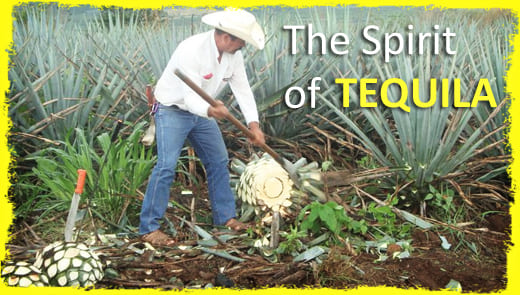
#MexicoToday – The fiery drink of Tequila has been rapidly gaining international popularity for years now, being featured in popular billboard hits and increasing in US consumption by 45% in the past 5 years. So it comes as no surprise that the town of Tequila, birthplace of the most representative beverage in Mexico and the proud producer of the worldwide spirit that bears its name, has also been gaining more and more attention. Recently, ABC, MSNBC, and USA Today all ran an article about this small town in Jalisco, Mexico – about 4 hours east from the popular tourist city of Puerto Vallarta (just outside Guadalajara, part of Mexico’s Colonial Heartland).
This acclaimed Magic Town sits against the Tequila Volcano which overlooks the valley encompassed by endless landscape of perfectly lined of blue agave plants. Built around Tequila’s main square of beautiful fountains and fresh flowers are the distilleries of popular producers such as Sauza and Jose Cuervo. Visiting the town of Tequila is a trip to the past, where the traditions and the most authentic aspects of Mexico are still alive and prevalent.
Curious about this traditional and legendary drink, I took the trip to discover Tequila for myself. Starting off with a visit to the 17th Century stone Santiago Apostol Church and a walk around the flourishing plaza, I filled my stomach with the juiciest Torta Ahogadas (pork sandwiches drowned in a spicy red sauce – famous to the Guadalajara region) before enjoying a small tequila to get in the right mindset. What many people do not know is that tequila is not something that should be taken as a shot. Rather it should be treated as a fine wine, acknowledging the various aromas and savoring ever nuance in flavor.
Appreciating the smells and tastes of the actual liquid is one thing, but a true appreciation of Tequila comes from seeing the process of its creation from start to finish. I learned this during my tour at Mundo Cuervo; where in a small VIP group, we visited fertile agave fields, wandered through picturesque courtyards of the hacienda and toured the actual production factory. With the largest distillery in Latin America, the Cuervo brand started distilling a private tequila called ‘Reserva de la Familia’, reserved only for the Cuervo family. As time went by, they decided to share a very limited amount which is exclusively made in Mundo Cuervo, housing only barrels of Reserva during a specific season. I was able to try a very small sample of this limited edition tequila, and not exaggerating, it was one of the best Tequila Anejo’s I had ever tasted.
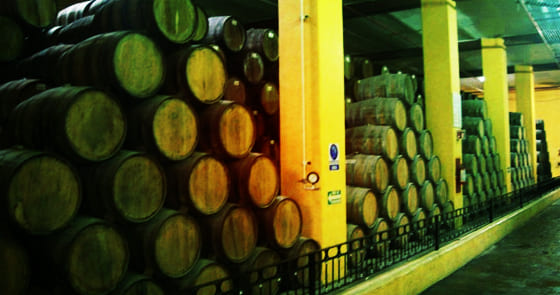
At the end of the tour, we learned how to distinguish quality tequila – much like you can distinguish a fine wine. One way is to swivel the tequila around in a glass and notice if any drops stick and form along the glass, the more droplets that adhere to the glass, the better the tequila. The other way, which I found most fascinating, is that Tequila has three very distinct scents depending on which part you smell. Starting at the bottom portion of your glass, this is the scent where you appreciate the key ingredient, the aged agave plant, distinguished by its pungent scent of alcohol. Moving up to the middle portion, it is differentiated by a sweet fruity floral smell, much less harsh than the fragrance at the bottom. Reaching the top one-third portion of your glass, the aroma changes from a nice spring day to a warm cozy fire, emitting a rich wood smell due to the aging process in the barrels. Detecting and savoring each scent and learning about the long process and stages it makes to produce tequila, I developed a strong appreciation and understanding of the intricate process.
After a 3 hour tour around the facilities and numerous taste testing and margaritas (complements of the tour), I headed to the National Tequila Museum where, through its collections, I gained an even deeper understanding regarding the cultural values of the tequila region, which I learned was recently declared a World Heritage Site by UNESCO.
Reflecting on my day trip, I learned more about Tequila then I ever thought imaginable, both the drink and the town. Both are unique and representative of the country in which they reside. Having only spent a day in Tequila, there’s still more to discover. The town has many “tourist friendly” facilities and tours, including the infamous Tequila Express train ride and the giant tequila bottle-bus city tour – which are on my list next time I am driving through!
Mexico Regains Title as World’s Top Beer Exporter

In the spirit of the weekend, we’re happy to report that Mexico has emerged victorious from what’s been a dogfight with Holland for the title of the World’s Top Exporter of Beer.
According to figures from the World Trade Organization, Mexico reported $ 1.876 billion in foreign sales for 2010, while the Netherlands amounted to 1.778 billion. The last time Mexico reigned in beer sales was 2006 as Holland has held the top spot since 2007.
It turns out the key to victory has been filling the frothy demands of consumers outside of North America. A recent article from Economista quotes Valentin Diez Morodo, senior vice president of the Board of Directors of Grupo Modelo, as saying: “Exports are good and have been successful in countries like Australia, which is already the second destination, exceeding in 2011 to Canada after the United States.”
Although Grupo Modelo owns many brands of beer, its Corona Extra is by far the most recognizable. In 2010, Corona Extra ranked 85th in the Best Global Brands 2010 ranking of Interbrand.
I mean, who doesn’t enjoy the thought of unwinding on a Mexican beach with an ice-cold Corona? Mmmmm… Happy Friday!
Our Mexico: Adventure
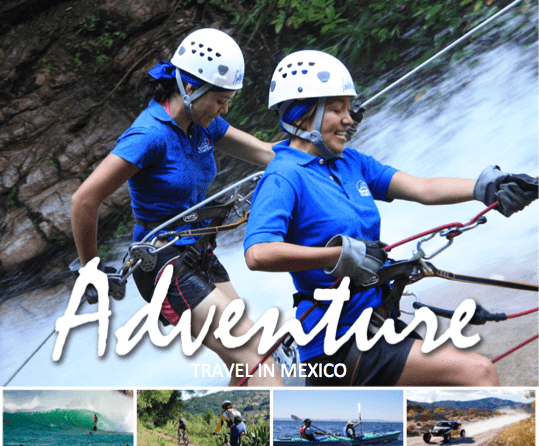
Click Image to View the Full Ad
The third web-ad in our Our Mexico series focuses on Adventure Travel in Mexico (click here to view the full ad). The main image features Journey Mexico staff members repelling down a waterfall during our annual staff-adventure day.
As noted in the ad, Mexico is home to endless opportunities for world-class adventure experiences of all age/skill levels. Did you know that in 2010, Red Bull held an extreme diving contest at one of our favorite cenotes in Yucatan? Check out Journey Mexico founder and president doing a little cenote jumping of his own.
Though Mexico has been flying under the radar for the past couple of years when it comes to adventure travel, the secret is out. In fact, the Adventure Travel Trade Association (ATTA), the largest international network of adventure travel companies and organizations, has announced that in 2011, their annual World Summit will be held in Chiapas, Mexico!
If you love adventure travel, click the image above then tweet the ad/or hit the Facebook Like button. Por favor y gracias!
New Mayan Sculptures Discovered in Tonina
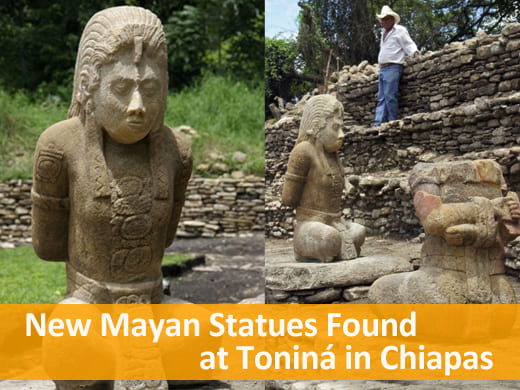
We’re excited to report that just days after we visited the site of Toniná, in southern Chiapas, Mexican archeologists discovered two ancient statues that many believe offer important clues as to the relationships between certain city-states of the time. The 1,300-year-old, life-size statues depict two Mayan warriors who are believed to have been captives of Toniná as their hands are bound behind their backs.
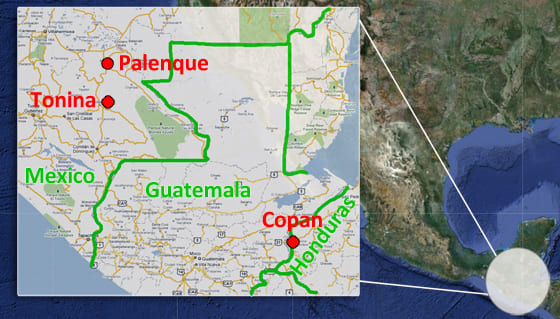
Hieroglyphic inscriptions on their loincloths and chest lead archeologists to believe that the warriors were from the city of Copan, many miles south of Toniná on the border of current-day Guatemala and Honduras. While local archeologists take these statues as proof that Copan had been fighting along side warriors from Palenque (north of Toniná) in a combined effort to control the Usumacinta River (which now marks the boundary between Mexico and Guatemala), David Stuart, a specialist in Mayan epigraphy at the University of Texas at Austin disagrees and feels that, “…these two statues refer to prisoners already known from other Toniná inscriptions, and I suspect they are probably more local to the Chiapas region.”
Stuart believes the main purpose of the sculptures was to commemorate a dedication of the ballcourt at Tonina on June 27, 696. Interestingly, two stone score-cards used during the ballcourt games were also found with the statues – many Mayan civilizations believed spilled blood “gave life” to structures like ballcourts and temples.
Either way, it’s clear that there is still much to be learned about the ancient Mayan civilizations of the region. As we often like to point out, what is currently visible at most of the archeological sites in Mexico is just a fraction the entire site. For example, the 30 temples and buildings of Uxmal are an incredible site explore, yet archeologists have yet to uncover more than 300 other structures at the site!
These findings in Toniná come just two weeks after we posted an article about a robotic camera that had captured new images of an ancient tomb at Palenque. As you can see, there’s never a dull moment for fans of archeological travel in Mexico!
Growing Mexican Economy a Big Incentive for US Assistance in the War on Drugs

While we continue to assure travelers that the majority of Mexico is extremely safe for travelers (which travelers from outside the US seem to understand very well), we do always acknowledge that specific areas of Mexico (mostly located along the US/Mexico border) do have a problem with violence and should be avoided. To the surprise of many, however, a growing number of people are interested in visiting and even moving to these troubled areas – industrial business owners from the US.
As Mexico’s economy continues to grow at a steady pace, more and more industrial businesses are looking to open or expand along the US/Mexico border, which (in conjunction with other growing economic trends) should serve as a pretty large incentive for the US to accept more responsibility for the violence in the area and to help take care of the problem.
For many readers in the US, that last sentence may seem a bit offensive, but it’s no secret that a significant number of the guns used by drug gangs come from the US. To be fair, President Obama has taken responsibility for a portion of the problem, yet many would argue that effective changes in policy have been slow to take place. As the Mexican economy continues to grow, it’s difficult to understand why the US would not be more interested in doing all they can to aid in the speedy resolution to the border violence.
According to the New York Times, the Mexican economy “grew 5.5 percent last year, its fastest pace in a decade, and is expected to grow 4.5 percent this year… The American economy, by contrast, is expected to grow between 2.7 percent and 2.9 percent in 2011.” The Times also added that “Mexico’s manufacturing sector increased 8.2 percent to 1.8 million as of January, the most recent figures available, driven mostly by what Mexican officials called regaining health in the auto and electronics industries, the engine of the economy along the border.” And it’s not just a thriving industrial sector within Mexico that should entice Americans to do more in stopping the violence as a strong Mexican economy directly boots the US economy, much more so than many realize.
Did you know that 22 states in the US report Mexico to be their number one or number two market for exports? In addition, Mexico is within the top five export-markets for many other US states. Theoretically, if the US would make stemming the sales of guns to Mexico (as well as dealing with it’s insatiable demand for drugs) more of a priority, violence in Mexico would drop and the Mexican government would have an easier time dealing with the cartels. Less violence would lead to less negative reporting in the US media, which would lead to more US tourism to Mexico. More tourism would cause Mexico’s economy to increase even faster, and Mexico’s rapidly growing middle class would have more money to spend on US exports. It’s a win, win (at least in theory), right?
So why isn’t it happening? Doesn’t everyone, on a humanitarian level, want to see the violence in Mexico ended? Doesn’t the US economy want to make more in exportation? Don’t US travelers want to save money by vacationing in neighboring Mexico instead of in destinations much further away?
There are only two explanations I can come up with: One, the sale of guns to Mexico accounts for more money than would be produced by the above scenario via exportation or, Two, the money from the sale of guns goes to a specific group of people capable of influencing policy. Which seems more plausible to you?
*Update – Shortly after I published this post, I came across this article published today on the Los Angeles Times website, which concludes with: “…it appears that the United States has been effectively — or inadvertently — sending weapons to Mexico’s government to fight cartels while also sending weapons to cartels that are fighting the government.”
Russian Tourism to Mexico to Increase 400% in 2012
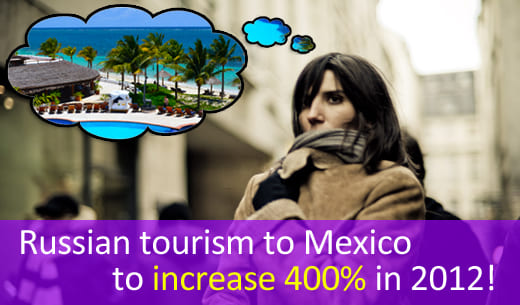
Last week, we published a post speculating about an interesting trend in tourism to Mexico. The theory goes something like this: The negative/slanted media coverage of Mexico pouring out of the US is hurting the Mexican Tourism industry, which has caused the industry to lower prices and offer enticing deals. These deals are being eaten up by international travelers from outside the US, causing an overall rise in tourism to Mexico. A recent press release from the Mexican Government seems to be adding validity to theory, predicting Russian tourism to Mexico to increase by 400% in 2012.
2010 saw 27,137 travelers from Russia, which was an increase of 134% increase from 2009. From Jan. to April of this year, Mexico has already welcomed more than 14,000 Russians, which is a 64% increase from the same time period in 2010. Taras Kobishchanov, the President of the Association of Tour Operators of Russia, said that not only is Russian tourism to Mexico expected to explode in 2012 but that if this trend of growth continues, Mexico could be seeing about 500,000 yearly visitors from Russia by 2018!
Even more interesting (and important for Mexico) is that the average group of Russian travelers spends about 10 days in Mexico, whereas US travelers usually stay for only 4.5 days per trip. In addition, Russian groups spend an average of $1,000 dollars a day during their travels in Mexico.
According to the press release, “The most attractive destinations for Russian tourists are: Cancun-Riviera Maya (64.8 percent), the Federal District (29.7 percent), Puerto Vallarta (1.7 percent) and Los Cabos (1.6 percent).”
Russian travel agencies have reported that the Mundo Maya program and the approach of 2012 have sparked great interest among their clients. To capitalize on this interest, the international airline Aeroflot has announced that they will begin new flights to Mexico beginning October 3rd.
Needless to say, this new influx in Russian travelers is great news for Mexico as the country continues its march towards the Top Five International Travel Destinations in the World.
#MexicoToday
New Positions at Journey Mexico
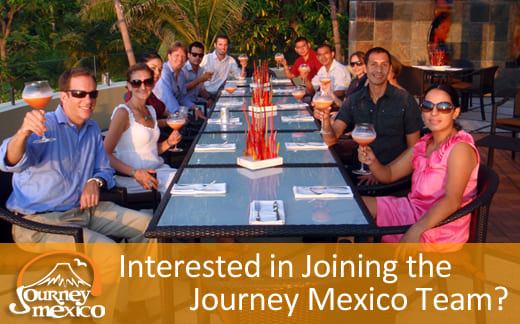
As Journey Mexico continues to grow, new opportunities have become available within our team. If you are interested in applying for either of the positions below, please email rebecca (at) journeymexico (dot) com with a subject of “Opportunities at Journey Mexico.”
Location: Puerto Vallarta, Jalisco, Mexico
Position: Travel Planner – 3-5 Years experience in sales and travel industry. BA required. Bi-lingual English/Spanish Required.
- Customer Sales and Account Management: To prepare, present and manage pre-sales proposals and pre-departure documents to groups/individuals incorporating unique itineraries, accurate pricing and clearly defined terms and conditions
- Operations: To follow the operations of Journey Mexico trips managed by the JM Operations Staff to ensure client satisfaction.
- Product Development: To develop and promote current and new products to be marketed through the Journey Mexico channels through scouting new itineraries, and creating new travel experiences for our unique clients.
- Marketing/Public Relations: To Represent Journey Mexico in client facing situations such as FAMs or with local clients.
Position: Operations Coordinator – 3-5 Years experience in guiding or operations in travel industry. BA required. Bi-lingual English/Spanish Required.
- To ensure near flawless execution of all trips booked through the Journey Mexico.
- To maintain high quality and current knowledge about Mexico to ensure unique itineraries, quality customer experiences and repeat clientele
- To improve Journey Mexico operations in Mexico through negotiating relationships with vendors, identifying guides and coordinating all the administrative aspects of the field with a high degree of accuracy, skill and customer service in all aspects of responsibilities.
Location: Cancun, Quintana Roo, Mexico
Position: Operations Coordinator – 3-5 Years experience in guiding or operations in travel industry. BA required. Bi-lingual English/Spanish Required.
- To ensure near flawless execution of all trips booked through the Journey Mexico.
- To maintain high quality and current knowledge about Mexico to ensure unique itineraries, quality customer experiences and repeat clientele
- To improve Journey Mexico operations in Mexico through negotiating relationships with vendors, identifying guides and coordinating all the administrative aspects of the field with a high degree of accuracy, skill and customer service in all aspects of responsibilities.
Position: Administration Assistant
- Check back shortly for details
The Approach of 2012 to Spark Mayan Tourism
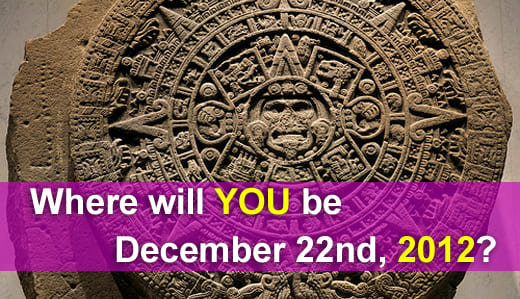
Most people don't realize that the calendar above is the Aztec calendar adapted from the Mayans
#MexicoToday: Ever since scientists/historians have discovered that 2012 marks a certain “end” to the Mayan Calendar, excitement has been abuzz about December of 2011. Although many would argue that most of the “end of the world” theories associated with the Mayan Calendar and 2012 are misinterpreted, most scientists and historians knowledgeable about the topic would agree that 2012 does mark “the end of something.”
During a recent trip to Chiapas, I had an interesting conversation with one of our top guides, Roberto, about the Mayans and their advanced skill in terms of astronomy. Roberto made a fascinating point when said that if you contextualize the Mayans with other civilizations of the world at the time, the Mayans were far more advanced in mathematics and astronomy, yet they were far behind in other areas of life as they were basically still living in “the stone age.” They could make nearly perfect calculations in terms of the yearly calendar but had yet to really discover the wheel. When I started to ask Roberto about the specifics of the Mayan Calendar and what it predicts, he said that was a whole different conversation that we didn’t have time to get into.
It’s that conversation, though, that seems so exciting. Does the calender predict the end of the world or just the end of a “cycle?” If it’s a cycle, what will the new cycle bring?
The possibility of finding the answers to these questions has enthusiasts from around the world interested in being in Mayan Mexico for the year’s end. Seizing this opportunity to bolster travel to Mexico, Mexican President Felipe Calderon has announced the launch of “Mundo Maya 2012″ (Mayan World 2012), a program designed to increase tourism and promote the Mayan Culture Legacy in Mexico through 2012.
A recent press release in regards to the program states: “Between now and Dec. 21, 2012, when the Mayan calendar officially ends, the Mexican government will promote a variety of events in southeastern Mexico’s “Mayan World,” made up of the states Campeche, Chiapas, Tabasco, Quintana Roo and Yucatan. This region is home to six of Mexico’s 27 UNESCO World Heritage sites, the most found in any one country.”
The Mexican government is investing money into improving the roads leading to the Mayan archeological sites as well as their facilities to prepare for the increase in tourism. The government has also said that they plan to make previously private sites available to the public for the program, which is exciting as Mexican archeologists continue to make new discoveries daily.
End of the world or not, the Yucatan Peninsula is poised to deliver an unforgettable New Year’s experience. Where will you be?
International Travelers Pick Up US Slack in Travel to Mexico
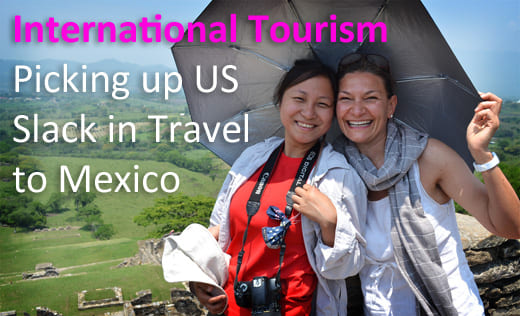
#MexicoToday: Two recent articles (one from the Washington Post and one from Sand Diego Red) are indications of an interesting scenario: The negative/slanted media coverage of Mexico pouring out of the US is hurting the Mexican Tourism industry, which has caused the industry to lower prices and offer enticing deals. These deals are being eaten up by international travelers from outside the US, causing an overall rise in tourism to Mexico.
Proof of this can be found in the continual increase in international flights to Mexico. The prestigious Virgin-Atlantic has recently reported that as of June, 2012, they will be adding a twice-weekly flight from London’s Gatwick Airport to Cancun. Virgin sees demand for Mexico rising and expects to carry 94,000 passengers during the first 12 months of service.
In addition to the new Virgin flight from London, airlines such as Aeromexico, Air Europa, TAM, and LAN have added new flights from Lima, Peru to Cancun; Sao Paulo, Brazil to Mexico City; and Madrid, Spain to Mexico City – many beginning in the next few months. Earlier this year, the Mexican Tourism Board said they anticipate 2011 to see up to a 15% rise in tourism (coming off 2010 which saw a 12% increase), but I doubt they imagined so much of it coming from outside the US.
So if the San Diego Red is right and it’s bargains that are driving this year-over-year increase in tourism, one must ask for how long is this bargain model sustainable? Now more than ever we’re seeing public backlash against the “daily deal” model as business owners continue to say that large discounts offered by companies like Groupon are not sustainable and do more damage to the business than good. If all these new tourists come to know Mexico as a land of cheap deals, how can the industry ever raise their rates back to normal?
Pretty easily, actually. According to the Mexican Tourism Board, Mexico boasts a 97% retention rate, meaning that 97 percent of travelers to Mexico say they plan on returning. Being almost two million square kilometres in size and home to more UNESCO World Heritage Sites than any other country in the Americas (including the US), it’s not surprise that Mexico leaves visitors wanting more. As tourism continues to increase, Mexico should be able to gradually raise rates to normal as demand rises.
In May of this year, Mexican President Felipe Calderón stated that he wants Mexico (currently number 10) to be one of the top five tourism destinations in the world by 2020. If current trends continue, international tourism continues to rise, and the US starts to realize that 99% of Mexico is perfectly safe for travel, Mexico should have a real shot at hitting the top five.
Mexico Today in Oaxaca
#MexicoToday – Last week we posted about how Jessica Seba and I were chosen to be a part of the Mexico Today program and today it is my pleasure to post a re-cap of the kick-off event that was held in Oaxaca over the weekend.
Welcome to Oaxaca
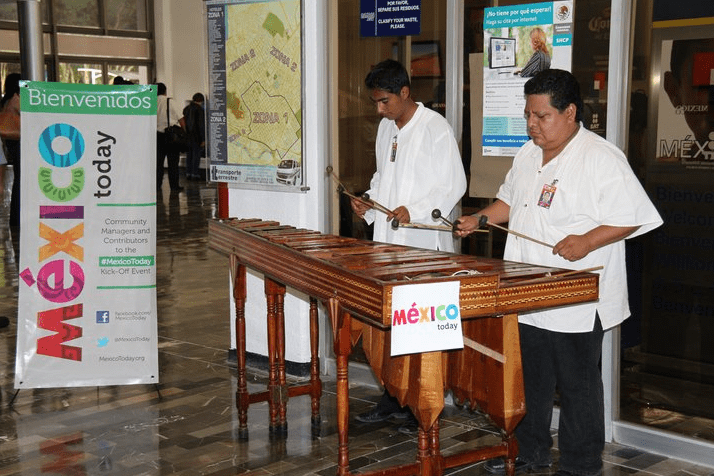
It was clear that the weekend was going to be a cultural treat immediately after stepping off the plane Friday as we were greeted by the traditional sounds of the marimba, a type of xylophone that originated in southern Mexico. After being transferred to our hotel, the gorgeous Camino Real Oaxaca, we met for an introduction cocktail followed by a mezcal tasting, which really put us in the spirit – pun intended.
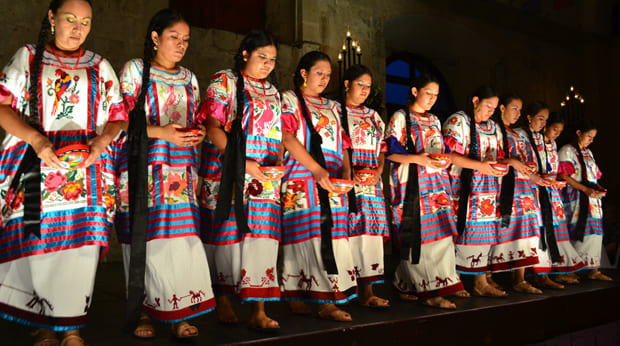
Guelaguetza Dancers
After we’d become well acquainted with tequila’s smokey sister, we moved to the old chapel of the Camino Real (the 5-Star Camino Real is housed in what was originally the convent of Santa Catalina) for a massive buffet of Oaxacan flavors. As we ate, a group of traditional dancers performed many of the dances of the Guelaguetza festival, which is an extravagant event that takes place on a hillside in Oaxaca each year.
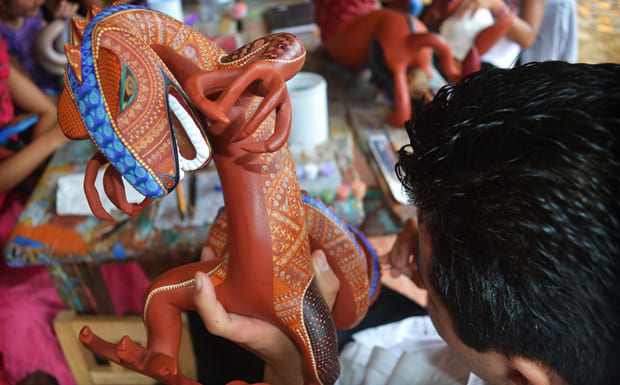
Alebrije in the making
Saturday began with an insightful meeting which included a panel discussion including guest speakers Antonio del Rosal Stanford (Mexican Brand Coordinator), Alejandro Ruiz (the famed chef of Casa Oaxaca), and Jacobo Angeles (a local artisan famous for his Alebrijes – brightly colored wooden figures). Following the discussion, we were driven out into the countryside to visit Jacobo’s workshop and learn about how the alebrijes are made. Before the demonstration, we were treated to more dancing, mezcal, and a fabulous lunch prepared by Jacobo’s family. During lunch, I was able to try chapulines for the first time, which are toasted grasshoppers – a traditional delicacy of Oaxaca. I must say, I quite enjoyed them and found them to taste like salted cranberries.
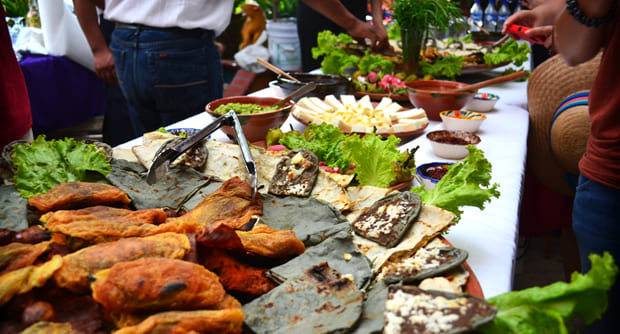
Lunch at Jacobo's Workshop
Returning from Jacobo’s workshop, we had just enough time to freshen up before joining a marching parade in the street (although a few of us snuck off to watch the USA vs. Mexico football match in a local cantina). Jessica tells me the parade was a highlight of the trip as our group carried colorful candles while they followed a group of traditional dancers through the streets – all the while being fed shots of mezcal. Some of our group were carried on the shoulders of some locals (atop a leather bull) and at the end of the parade, the group was greeted by a giant “Welcome Mexico Today” in fireworks. Back in the cantina, we saw fireworks of our own as the US went up 2-0 on Mexico, only to be destroyed 4-2.
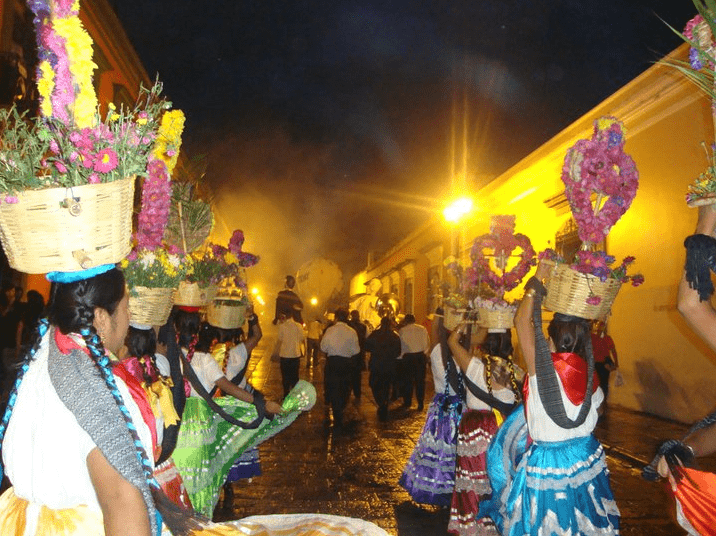
Parading the streets of Oaxaca City
The group reconvened at Casa Oaxaca where chef Ruiz prepared a delicious three-course meal consisting almost exclusively of local meat and produce. Chef Ruiz has been a huge proponent of the “Local Foods” movement as growing and using your own food and produce has always been a way of life in the fertile lands of Oaxaca.
Dinner was followed by drinks on the town square, where we were serenaded by local mariachi bands and a few passing troubadours. Drinks were followed by more drinks in a cozy cantina around the corner from the Camino Real, which, for some of us, made for an interesting Sunday morning meeting. Grogginess aside, the farewell meeting was touching. I think I speak for the group when I say it was a true pleasure to meet so many talented people who all share a real love for Mexico. Journey Mexico, Jessica, and I are all honored to be a part of such a committed group, and we’d like to thank the Mexican Tourism Board, Marca País – Imagen de México, and Ogilvy for putting together such an inspired initiative and such a wonderful event.
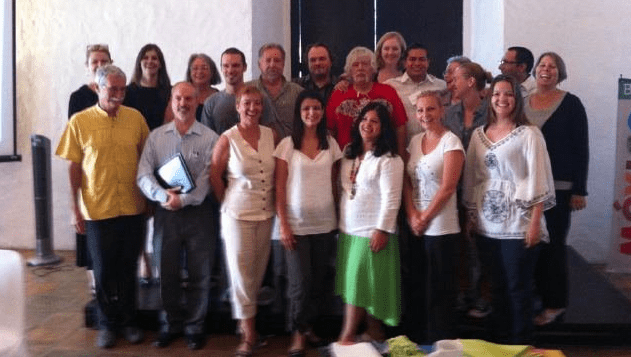
The Mexico Today Team (Most of us)
Stay tuned to www.facebook.com/MexicoToday for posts from the group of contributors and be sure to follow #MexicoToday tweets for all the real-time happenings in Mexico!
New Images of Ancient Tomb at Palenque
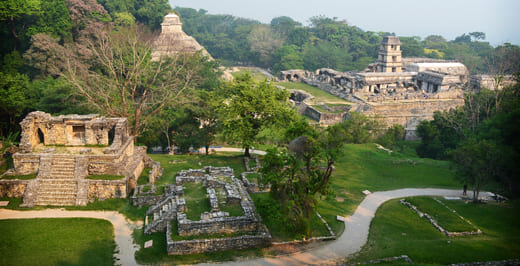
The Ancient City State of Palenque
In January, we published an article about a robotic camera used to explore an underground tunnel running under the Pyramid of the Feathered Serpent at Teotihuacan. Recently, another robotic camera has been used to produce the very first images of an ancient tomb at the archeological site of Palenque in Chiapas.
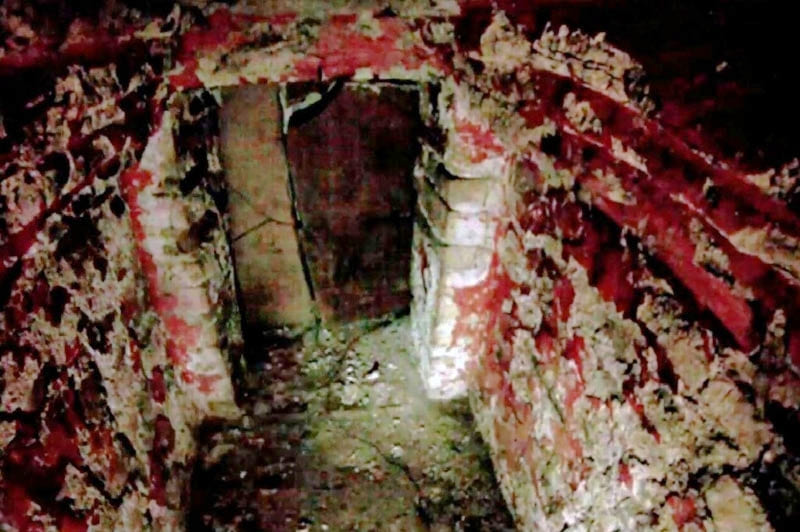
New Murals Found in Ancient Tomb of Early-Classic Palenque
Palenque is most known for the impressive pyramid called the Temple of Inscriptions, which is the burial site of a Pakal, a Late-Classic ruler of Palenque. The later rulers of Palenque are known to have written extensively about Palenque’s long history but because the Mayans (under the rule of Pakal and his successors) built what is currently seen at Palenque on top of they structures of the Early Classic dynasties, researchers have had a difficult time getting to the older structures.
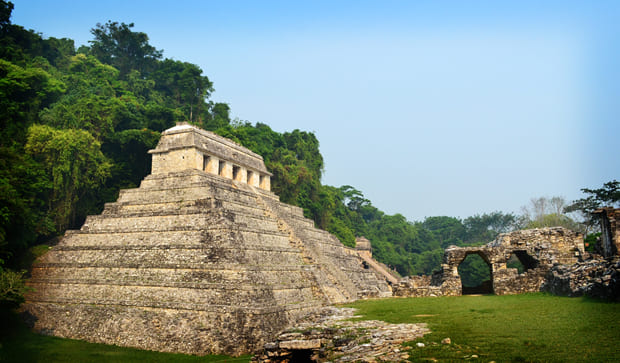
Temple of Inscriptions
This newly explored tomb is located in the Southern Acropolis area of Palenque and is believed to be approximately 1,500 years old. The remote-controlled camera that was lowered into the tomb has revealed an “apparently intact funeral chamber, with offerings sitting on the floor. Wall murals depicted a series of nine figures, painted in black on a blood-red background.” A funerary costume of jade and shell were also seen, indicating that the site is most likely a royal necropolis possibly containing the remains of K’uk’ Bahlam I, the first ruler of the city-state.
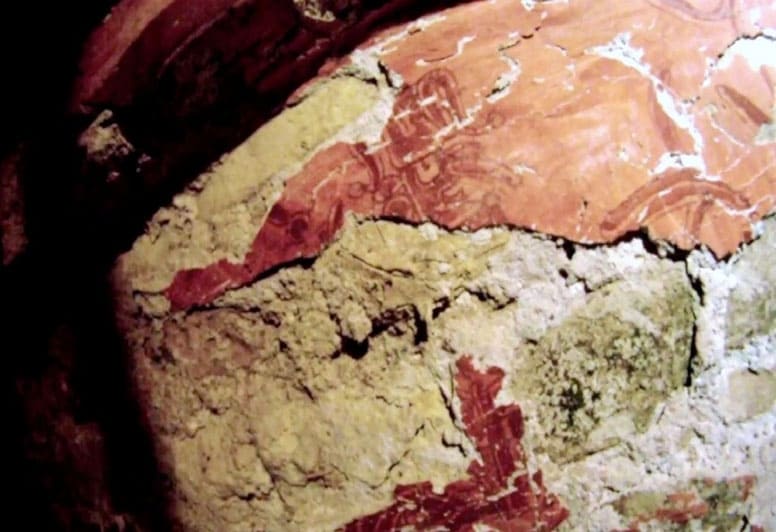
1,500 Year Old Paintings Found in Tomb
Because of the date and on the identities of ancestral figures painted on the walls, there is also speculation that the tomb is the burial site of a noted female ruler of Palenque named Ix Yohl Ik’nal. If true, this would be the second remains of a female ruler found at Palenque, the first being those of the famous “Red Queen,” believed to be either Pakal’s wife or mother.
These new images (as we often like to point out) illustrate the continual opportunity for those interested in archeological travel to literally witness history in the making here in Mexico. It is believed that only ten percent of the archeological site of Palenque has been excavated, which is common as most of the Mayan archeological sites in Mexico still have much to be discovered. Stay tuned as we report on new findings as they are uncovered!
Mexico Today

It’s been over a year since the Journey Mexico blog was created to encourage others to engage in Mexico, to learn about Mexico, and possibly be inspired to travel with Journey Mexico! The blog has become a home for not only Journey Mexico accomplishments and expertise, but for all things fascinating about Mexico including articles about festivals and events, destinations, and facts.
Through our daily posts, lovers of Mexico are able to follow along as Mexico strives to make 2011 the “Year of Tourism” through the good, the bad, and the ugly. As in-country enthusiasts, we make it our business to promote the phenomenal travel experiences Mexico has to offer as well as combat biased media aimed to discourage travelers from Mexico with factual and personal coverage of current events.
The success of the Journey Mexico blog has recently attracted the attention of the Mexico Tourism Board’s Marca Pais – Imagen de Mexico initiative. The Mexico Today program is designed to give a louder voice to the positive happenings in Mexican economy, security, health, infrastructure, environment, and culture/travel.
Journey Mexico is proud to report that two members of our web-marketing team, Chase Buckner and Jessica Seba, have both been chosen as two of the sixteen contributors for Mexico Today, where they will share their honest and genuine opinions towards Mexico and reveal their experiences and expertise.
Today, Chase and Jessica, will be traveling to Oaxaca for the kick-off event and to meet their fellow participants – some of the best when it comes to the promotion of Mexico representing sites like: The Mexico Report, Mexico Unmasked, Stay Adventurous, Go Mexico Guide, Cancun Canuk, Mexico Guide, The Other Side of The Tortilla and Midwestern in Mexico, (just to name a few)!
As the project launches, we invite you to become acquainted with MexicoToday.org, join their Facebook page and follow them on Twitter. Also, follow along on Twitter as Chase and Jess post updates and photos from Oaxaca this weekend using hashtag #MexicoToday.
Mexico Today, in association with Marca País – Imagen de México, is a joint public and private sector initiative designed to help promote Mexico as a global business partner and an unrivaled tourist destination. This program is designed to shine a light on the Mexico that its people experience every day.
Disclosure: Chase and Jessica are being compensated for their work in creating content as Contributors for the México Today Program. They are being invited to an all-expenses paid trip to Oaxaca for the kick off event for the Mexico Today program, where they will partake in several discussion groups and training activities. All articles posted with the “#MexicoToday” disclosure are the opinions of Chase and/or Jessica alone.
The Cultural Crossroads of San Juan Chamula
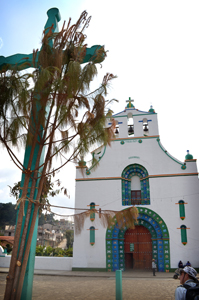
Green Cross Outside the Church of Chamula
One of the most interesting stops on a recent trip through Chiapas was in a small town just outside San Cristobal de las Casas called San Juan Chamula. Our excellent guide Roberto had informed us on the way to the town that its people were some of the last Mayans to succumb to the Spanish and that their rebellious spirit has lived on since as the town currently holds a special autonomous status within Mexico. No outside police forces are permitted in the town. In terms of religion, the church of San Juan Chamula has gained legendary status due to its complex mixture of Christian and Pagan beliefs.
On the outside, the church of San Juan Chamula looks like most any Christian church of its time period yet when our guide asked us why we though the giant cross outside the church was painted green, we quickly realized that the Chamula church was anything but typical (Mayans paint the crosses green in homage to Mother Earth and The Sacred Tree of the Maya). Upon entering the church, we immediately noticed more green as there were no pews in the church and the floor was covered in fresh pine needles (also in tribute to Mother Earth).
Seated on the pine needles were several groups of people, each with their own family shaman who were there to heal the sick. The people of Chamula ran their priest out of town some years ago; however, they do allow the priest to return on certain occasions to baptize the children, but he is forced to leave again immediately after the ceremony. In the priest’s absence, the people of Chamula line the church floor with rows of candles and burn incense to achieve the proper mood for healing and prayer. Needless to say, the priest strongly disagrees with these practices and even more with the alcohol that is consumed in the church.
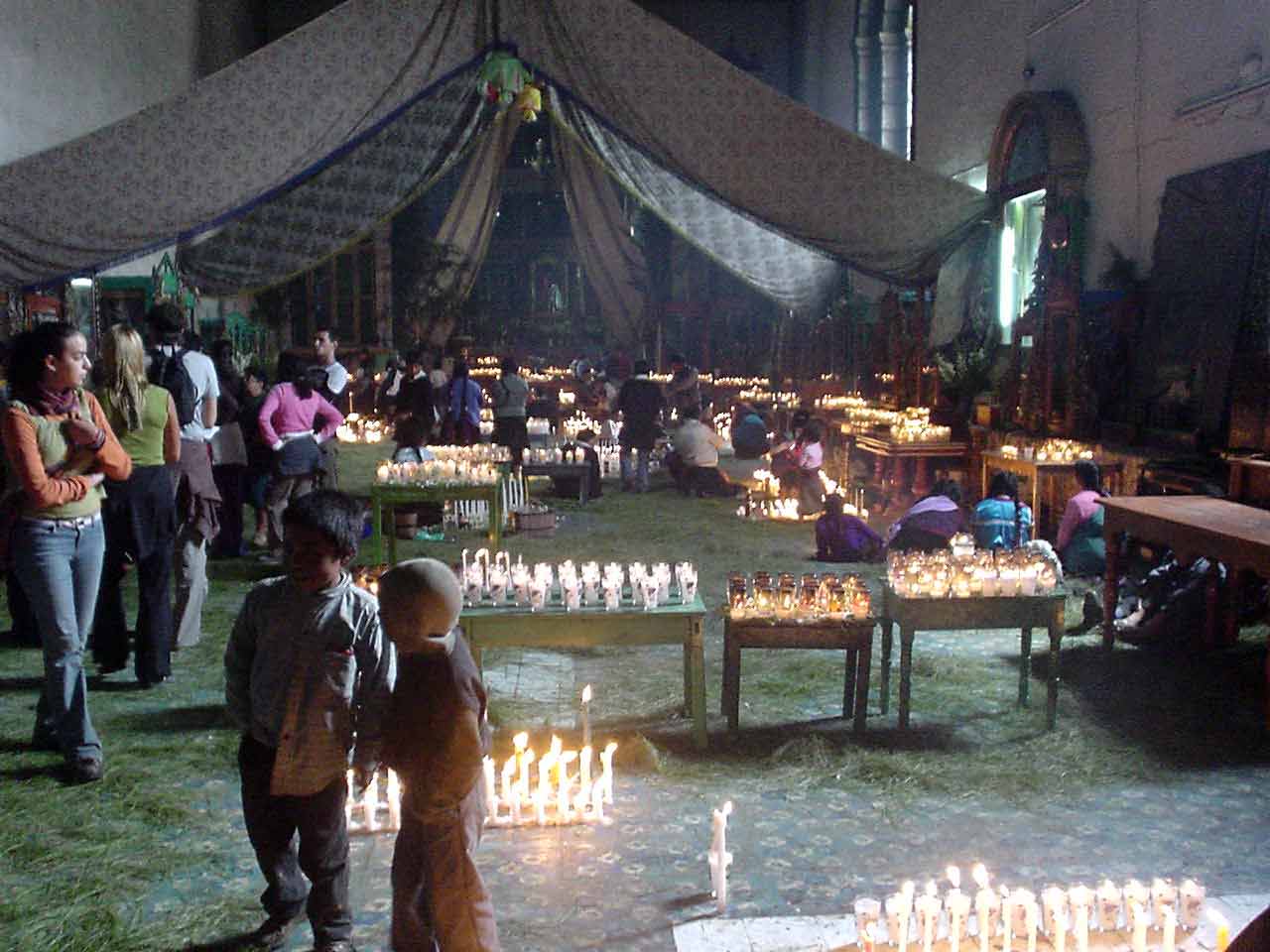
Photos are forbidden inside the church, but a few have found their way to the internet
Pox (pronounced “posh”) is an alcohol brewed of sugar cane and pineapple, which the shaman drink during their rituals of healing. They also pour the drink out on the floor for the saints as the saints are more likely to grant favors when they’ve had a bit to drink. In between drinks, the shaman chant the names of the saints of whom they are asking for help in repetition, creating a constant buzz in the air.
During the chants, many of the shaman were rubbing the bodies of their patients with eggs, which Roberto told us is a common practice used to heal. In more serious cases, a live chicken was rubbed on the individual before having its neck snapped by the shaman. This, Roberto explained, was because the people of Chamula believe that when someone gets really sick, it is because evil spirits have taken a piece or pieces of the person’s soul. To retrieve the missing soul, the shaman offer the life of the chicken in exchange for the stolen pieces. During the forty or so minutes we were in the church, I believe I saw at least three chickens killed in offering.
Surrounding the groups of shaman and patients are the statues of the saints to whom the people of Chamula pray. It was the presence of these status, undeniably catholic figures, that really intrigued and confused me. If the people of Chamula have already thrown out the priest, why keep all the Catholic/Christian relics? Long story short, Roberto explained that way back when the Spanish were establishing control, the Mayans had to accept a certain degree of Christianity to keep from being persecuted. On the flip side, the Spanish Catholics found it easier to establish control if they allowed the natives to weave their beliefs into the Catholic traditions. The result was a sort of mash up of the two religions, which, over time, became the norm.
Normal to us, however, it was not. I was fascinated by the range of reactions to the church from our group (which consisted of 13 travel experts from around the world). One thing I think we all agree upon was that visiting the church of San Juan Chamula is a true and unique travel experience not to be passed up. Watch the video below for the reactions of a few of our group members. If you’re interested in learning more about the church at San Juan Chamula, there are two great articles at forteantimes.com and www.philipcoppens.com.
2011 Pan American Games in Jalisco, Mexico
 2011 marks the 16th Pan American Games during which 6,000 athletes from 42 nations will compete in 36 sports. By hosting the games this year, Mexico will become the first country to have hosted the event three times. This years Pan Am. Games will take place on October 14–30 and will be the largest multi-sport event in 2011.
Adding extra excitement to the event is the fact that the opening ceremonies will take place in Guadalajara’s new architectural masterpiece, Omnilife Stadium, which is now home to the city’s beloved Chivas football team.
Omnilife Stadium was designed to look like a volcano with a ring of clouds hovering above it. The stadium is both literally and figuratively green – lush grass covers the exterior of the complex and the stadium was designed to be a modern example of eco-development.
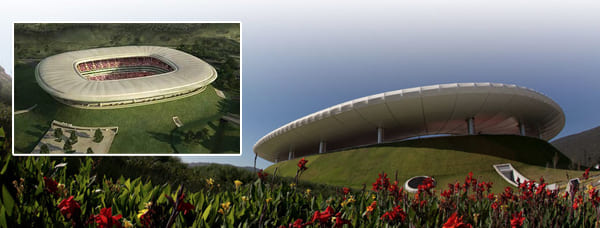
Guadalajara's New Omnilife Stadium
Before the opening ceremonies, an Olympic flame will be lit at the ancient pyramids of Teotihuacan, just outside of Mexico City, and will travel for fifty days through all 32 of Mexico’s states before arriving at the Omnilife stadium.
Though most of the 2011 Pan American Games will take place in Guadalajara, certain events like sailing, marathon swimming, triathlon, and beach volleyball will be held on the state’s coast in Puerto Vallarta.
Black Pottery in Oaxaca: A True Travel Experience in Mexico
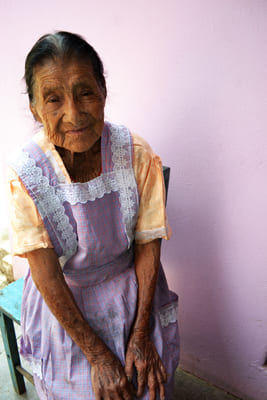
Doña Sophia of San Bartolo Coyotepec
Journey Mexico has always prided itself on offering travelers true travel experiences, meaning you’re not going to visit Oaxaca and just see examples of its famous black pottery; you’re going to visit a local home where a family of potters have been hand-making black pottery for centuries. You’re going to actually see the pottery being made. You’re going to meet and converse with the family and when you leave, you’re going to be sad to say goodbye to new friends.
The most recent Our Mexico web-ad features Doña Sophia, someone I feel privileged to have met on a recent trip to Oaxaca. So old she can no longer remember her own age, Doña Sophia still happily crouches down on her knees to give guests a live demonstration of how she has been making black pottery for almost a hundred years.
Unlike modern potters, Doña Sophia still spins her clay by hand on plates as opposed to using a mechanized wheel. As the craft was taught to her by predecessors, she has passed her knowledge down to her family and many of her daughters and granddaughters now decorate the crafts she molds before they are fired in an underground oven. In the video below, you can watch Doña Sophia in action as she crafts a jar for one of our recent groups.
Mexico Getting a Bad Rap
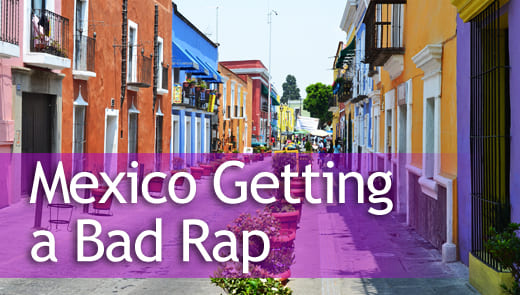
MSNBC has recently published an article called Time to Say Adios to Mexico? containing wildly misleading statements about safety in Mexico and insinuating that Americans have collectively decided to stop visiting Mexico altogether.
The article begins by stating that 34,000 people have died because of the drug war, yet it does not point out that that virtually all of the drug related violence has taken place in only a few specific boarder towns or that tourists and innocent bystanders have not and are not being targeted. The article makes no effort to contextualize these numbers with US murder figures as they would have had to acknowledge that Mexico has a murder rate of about 9.8 per every 100,000 people, which is actually less than that of US cities like Phoenix (12.6), Houston (12.5), and Los Angeles (17.1) (source).
The article then insinuates that tourism to Mexico is declining, when US investments in Mexico, US flights to Mexico, and the numbers themselves show otherwise. According to the World Travel and Tourism Council, the number of foreign tourist arrivals to Mexico in 2010 was 22.4 million – a 7% increase from 2009 and 2% more than in 2008, which was one of Mexico’s best years in history.
The US has been catching heat from international critics since they increased the State Departments Mexico travel warning with broad, misleading statements that don’t accurately specify the specific regions of danger. There’s been much speculation as to why the US media has been so relentless about publishing negative press related to Mexico, but one thing is certain – they’re not playing fair and it’s influencing a whole lot of Americans. In this recent post from MSNBC, they’ve included a poll asking “Would you visit Mexico given the worsening violence in some areas?” As of the time I am writing this post, 76% of the 20233 who have voted answered No.
If you’ve been to Mexico and can attest to its safety (like these recent travel experts) or if your just a fan of responsible reporting in general, please click here and vote “Yes” (the poll is below the picture to the right of the text) to show Americans that not everything is as your TV would lead you to believe.
Central & Southern Mexico Trip Photos
It took a while to get through all the photos, but here are the highlights from a recent trip through Central & Southern Mexico. You can turn the captions on and off by clicking the little speech bubble at the bottom left of the slideshow. Clicking a photo will take you to full sized version in our Picasa album. Let us know if you’ve been to any of these places or seen any of these things in person!

CHOOSE A DESTINATION