Jan 9, 2026
We jumped into the back of the minivan, the cool of the long winter night still hanging on, and headed east, out of Oaxaca. It was another banner day for Trump, he just announced he was pulling our country out of almost a dozen United Nations organizations. The same U.N. our country led the creation of eighty years ago to reduce the threat of the planet’s nuclear destruction. Our nation’s memory is short.
The traffic through town was heavy at first due to some construction, but soon we were rumbling down the valley east of town. Out the windows, occasional shops, roadside food stands, and nurseries blurred by, and in the distance –bare foothills hid the miles of mountains extending to the north toward Mexico City and to the east toward the Yucatan.
Today’s trip is to visit a “traditional” Zapotec family and learn how they make mole. Mole, in my mind until just the other day, was a thick and smooth hot pepper and chocolate salsa that went with Mexican chicken or pork dishes. How little I knew. Turns out mole is not just one thing but more like curries in India or gravies in European cuisine, it’s a class of salsas that are as varied as the cooks and chefs across Mesoamerica who make them. As we are to find out, moles might be made from one type of pepper and a few basic ingredients like corn, salt, garlic and onion. Or a mole might have twenty or thirty ingredients in it. I think we are about to learn a bit more about mole,
We arrive at the family house in Teotitlán del Valle. But before the five of us get out of the van, a short lesson in Zapotec hospitality and guest etiquette. Turns out the Zapotecs have a special room near the front door of the house that acts as both a chapel and a greeting room. It holds their altar and their ancestral archive. One wall for Jesus and one wall for photos and diplomas of fathers, mothers, and grandparents. The alter itself has a gospel half and a Zapotec half.
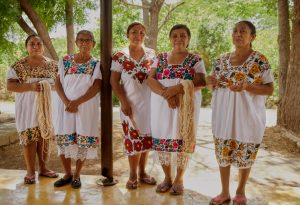
Ludina and Faustino (late middle ages) stand on the gospel side of the altar facing the five of us. They look small, and gentle, and older than their years. They seem shy but not a hint of nervousness and in fact also portray sturdiness and certitude. After a pause for us to settle down and face them, Faustino launches into a rapid-fire pronouncement in Zapotec – guttural, staccato, words slamming to an end as if into a brick wall. Then he switches to Spanish and the clarity of his consonants lets me feel my way through his sentences. He’s introducing himself and his family and expressing gratitude for our presence in their house. Ludina quietly, patiently waits her turn to shake our hands individually and look straight into our eyes with the steadiness that
melts my 21st century cynicism. We collectively fall into another world; one we weren’t expecting. In those few minutes of formal greeting, we travelled through hours of getting comfortable with these two. We learn that Faustino’s family has lived in this house for fifteen generations now.
Fifteen generations, that includes their son and granddaughter, so Ludi and Faustino are the thirteenth generation in this house. Hard to wrap my head around this so I do a little math. Even at 25 years per generation, that’s roughly 325 years ago that the first of his ancestors inhabited this small plot of land. How can I even imagine what life was like here for this family in the year 1700. We are about to find out.
Greeting formalities over, Ludi motions to follow her up an exterior stairway. Almost everything is outdoors in this concrete and corrugated tin compound. We walk past a couple dozen skeins of drying wool yarn, all the colors of the rainbow. As I start up the stairs, I see across the triangular courtyard a couple of looms with rugs in progress.
The stairs lead to an open kitchen; I can’t tell if we’re on the roof of the house or simply on the top floor which is open to the elements on two sides. I think we’re on both. It’s an exhilarating architecture either way – a rooftop working kitchen. We come around a corner and there is a concrete wood stove. It’s probably six feet by three feet. There are two fireboxes, one on either side. Ludi maneuvers the ends of two oak logs over a small pile of coals in one of the fireboxes. The oak, we’re told is from the mountain forests just a few kilometers up the road from the edge of town. We don’t see any trees when we look out from our rooftop perch.
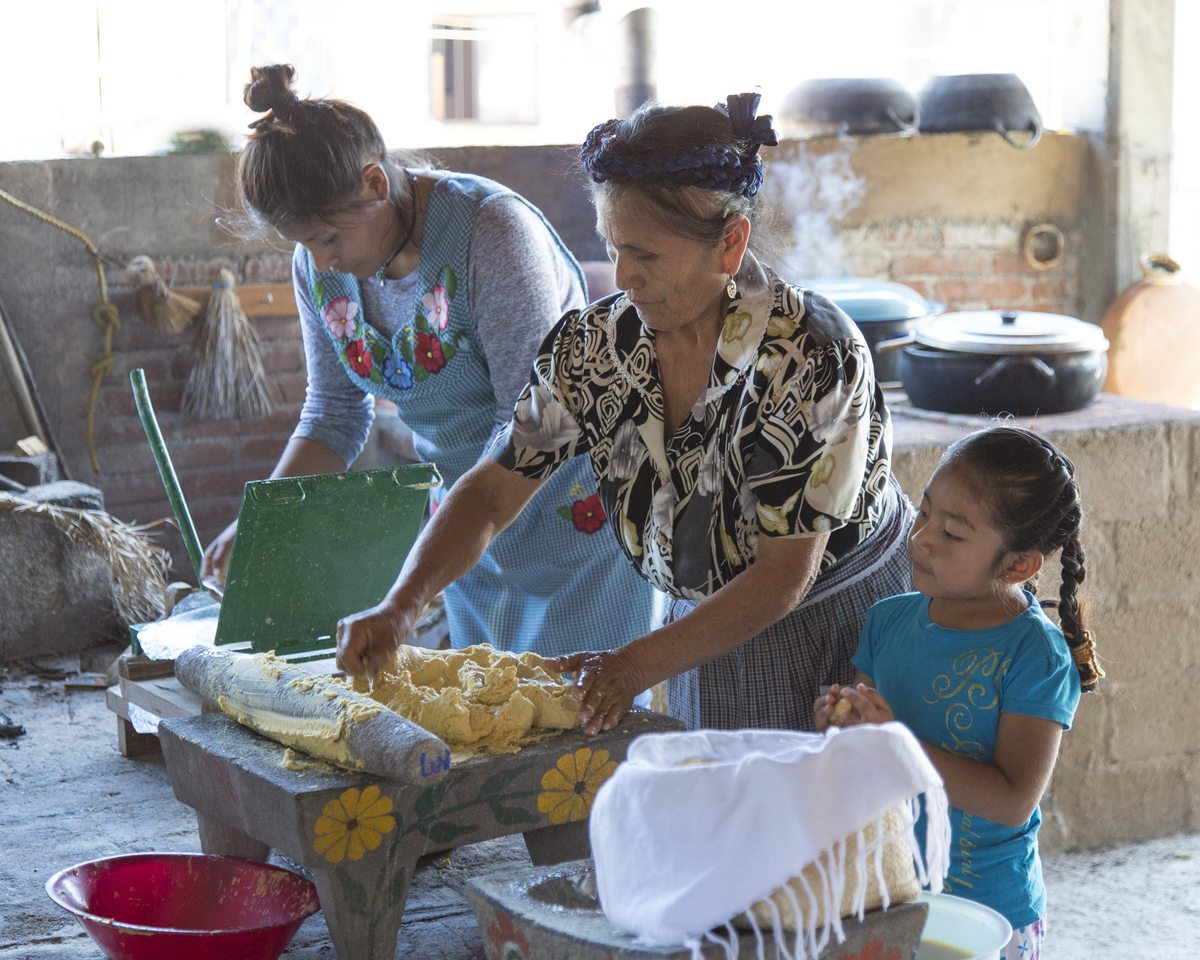
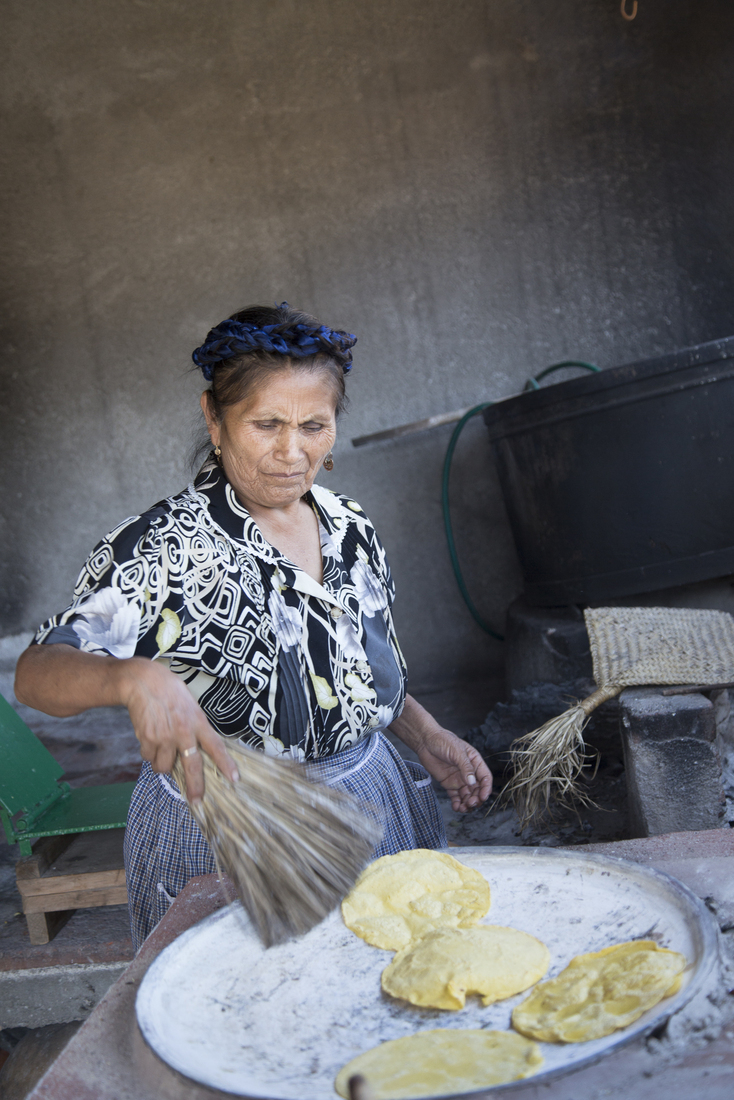
Ludi had arraigned five metates on a long table for us. Each has its matching grinding stone. There’s a sixth metate on the table. It’s miniature, It’s Ludi’s four-year-old granddaughter’s. Ludi’s eyes brighten when she talks of her granddaughter learning to make mole. We are going to make mole now, starting with a wicker tray of ancho and quajillo chilis that were harvested back in July. We slice them longitudinally on one side, scrap out the seeds, and then flatten them out carefully so they don’t rip. This makes them easy to evenly toast on the stovetop. Ludi, cures the comal each morning with lime to keep the chiles from sticking to its broad, flat surface.
We are simply lightly roasting these chiles to soften them prior to grinding them on the metate. It just takes about thirty seconds per chili, and the cooking surface is so big that Ludi and several of us can be roasting chiles at one time. We’re pressing on the chiles anywhere that the wrinkly pepper is not touching the surface. We’re trying to get them evenly toasted without burning them. Burning them would result in a black mole and that’s not what Ludi wants today. After we’ve toasted them, Ludi looks through them one by one and quickly tosses a few back on the stove – “un poco mas”. It feels like Ludi has performed this quality check thousands of times before. She probably has.
Back at the table, Ludi pulls out a wicker tray of yerba santa. We taste it, “wow – how come we never use this herb” and tells us to break the large teardrop-shaped leaves into small pieces. Next, we each take our station at a metate, and Ludi gives us some roasted peppers and yerba santa leaves to grind into paste. As I grind or rather scrap and roll with my cylindrical grinding stone, I make a mess. I’m about to throw up my hands in despair when our very present Zapotec goddess of mole comes over to me and quietly says, in the clearest Spanish, “that’s good just a little bit more”.
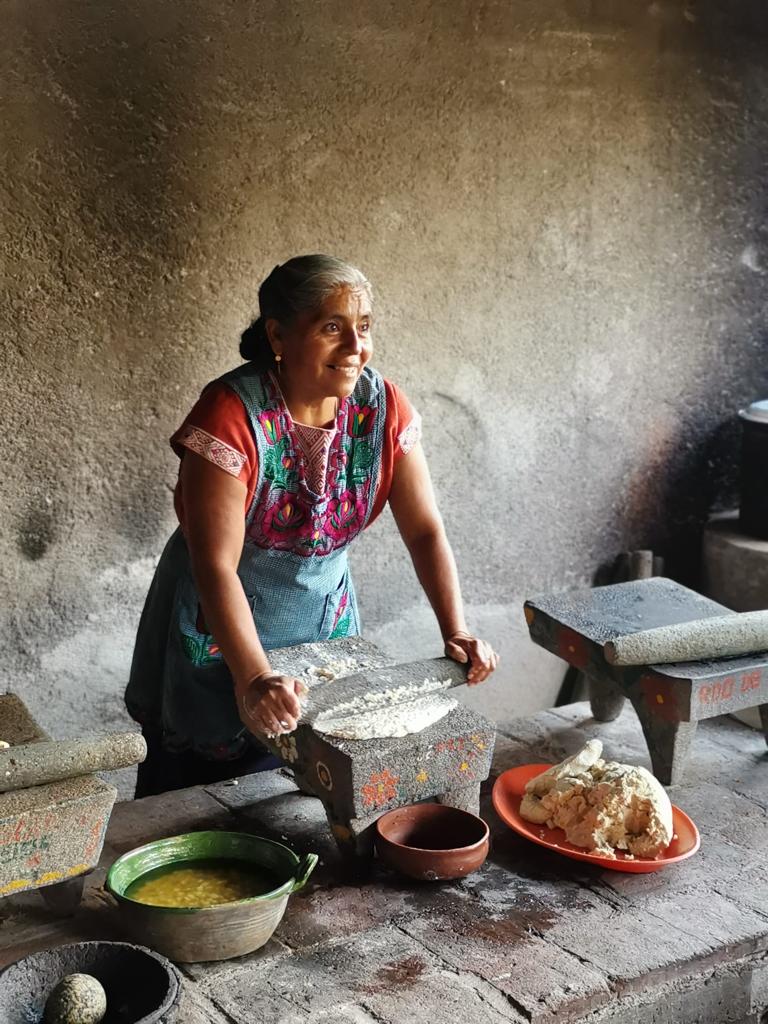
I have bits of pepper skin, pepper paste, pepper oil and pieces of leaves scattered all over the metate and the grinding stone. She suggests I add a bit of water which she does for me the first time by just dipping her fingers into a nearby gourd of water and flicking it onto my working surface. She hands me a wooden spatula and motions that I scrape my work into a pile in the center of the metate. The small pile gives me hope. A few more minutes of scraping, rolling, and praying, and she pronounces my paste ready for the next step. I scrape my paste into a small platter Ludi is using to collect the results of our grinding work. She hands me a hunk of corn-meal dough and motions for me to use it to sponge up the remains of the paste. She says the cornmeal is an ingredient of the mole and is going into the same pot as the tomato paste anyway.
Back at the stove, Ludi removes the cooking platter that we roasted the peppers on and places a large ceramic pot over the wood fire. She pushes the two oak logs a little further onto the coals and the flames pick up again. To some chicken stock (onions, garlic, water and chicken) she adds all the pepper paste, hands a long stick to my wife Freda, and motions for her to stir slowly and constantly. Ludi, adding chicken stock, and Freda, stirring, the liquid thickens. Another culinary success in just a few minutes, and all without a Cuisinart! Ludi scoops a little mole onto the back of her thumb, like a Russian Czar eating caviar, licks it, and decides one last spoonful of salt is just what’s needed.
We gather round, press tortillas, pull chicken, assemble tamales and wrap them in soaked corn leaves. I don’t mention all of this because we’ve just discovered the ultimate method for making tamales. Certainly, there are faster ways, it’s just this family continues to make them today, this pains-taking way, with tools and techniques they’ve passed down for generations, and continue to pass down. The past is present here. And the gentle care and keen awareness that Ludi exhibited during the cooking process is emblematic of the integrity of life this family leads.
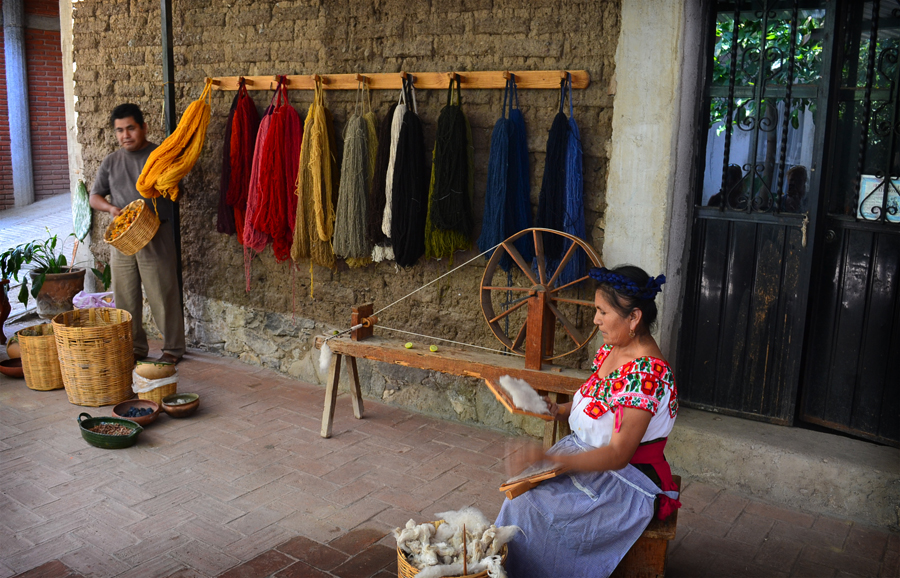
We head downstairs to talk with Faustino about the family business of weaving rugs. Evidently the family has been weaving in this house for as long as they’ve been living in this house. One of the half dozen looms is from the 1600s. Rough-hewn wooden legs and beams repaired through the centuries and currently being used by Ludi to weave a rug with a copy of a Picasso image.
Ludi takes up to six months to weave a rug as she spends much of her day cooking for the family.
Faustino’s whole family is in the business of rug-making. Here that means maintaining and repairing the looms, trading for different colors of wool with nearby shepherds, spinning yarn, and conjuring dyes from local natural sources. That includes several herbs for yellows, blending with indigo for all shades of blues and greens. On a bit of prickly pear cactus hanging nearby, the family cultivates the cochineal beetle. They’re practiced with using cochineal for making reds and the intricacies of adding acid (lime juice) or alkaline (lye) to create various shades of reds and purples.
Faustino is equally gracious showing us how he operates the looms, he’s weaving a Zapotec warrior image onto a rug. He holds up a line drawing of a Zapotec warrior; the size he wants the image to be on his final woven rug and then shows us the lines from that drawing that he’s transferred to the warp to guide him as he weaves.
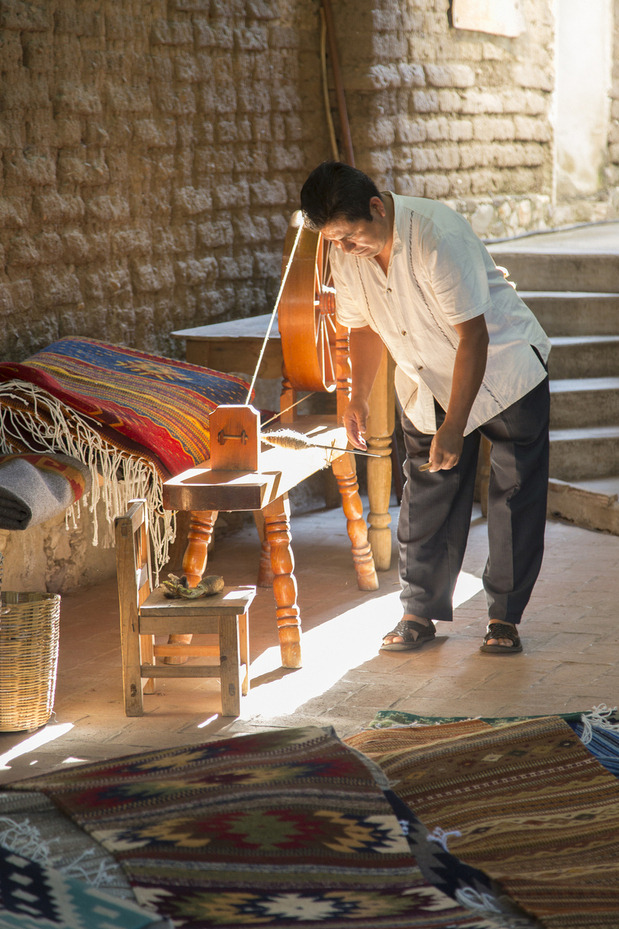
Their son and daughter-in-law, along with several other family weavers are creating typical patterned rugs. Across the courtyard, the pile of finished rugs stacked neatly under a large overhang is filled with the complexity of patterns and breadth of colors you would see in any metropolitan rug shop – brightly elaborate red and orange patterns to subtle plays of natural wool colors, almost Japanese feeling. And all the rugs we looked at closely, had not a weave out of place.
On our drive back to Oaxaca, we gradually come back to our current time, but as we entered the center of the city, the crowds on the street were still startling compared to the family home on a quiet street in Teotitlán de Valle. On our day trip to the countryside, I thought we were going to learn how to make mole. In the end, I took away much more. I saw how people were before the last 300 years of industrialization. Not just what they did, but how they saw themselves and how they treated others. It wasn’t just the kindness, but the sincerity of movement and of human interaction. There was no hidden motive, for a family that lived with such meager means, there was no stinginess, no desire to be anything different than what they already were. They had arrived at a destination we had long ago lost the map to.